Broad, united resistance is both urgent and possible
PV staff
Across the country, First Nations organizations have expressed determined opposition to Ottawa’s recently passed Bill C-5, the so-called “One Canadian Economy Act,” arguing that the legislation will fast-track large-scale infrastructure and resource projects by allowing federal ministers to bypass environmental reviews, provincial collaboration, and the obligation to obtain First Nations’ free, prior and informed consent.
Bill C-5 is part of a wave of development-oriented legislation that federal and provincial governments have introduced in recent weeks, nominally in response to Donald Trump’s tariff and trade war with Canada. In fact, virtually every one of these bills – including Bills 14 and 15 in BC, Bill 54 in Alberta and Bill 5 in Ontario – is designed to expedite and extend corporate profiteering by circumventing Indigenous rights and existing labour and environmental regulations.
On June 11, the Union of BC Indian Chiefs (UBCIC) unanimously passed a resolution opposing Bill C-5 and calling for “coordinated First Nations response.” The UBCIC warns that the legislation is in complete opposition to the United Nations Declaration on the Rights of Indigenous Peoples (UN Declaration) as well as Canada’s own United Nations Declaration on the Rights of Indigenous Peoples Act (UNDA).
Noting that the legislation seeks to enable ministers to deem projects “in the national interest,” granting near-automatic approval and overriding vital regulatory and consultative processes, UBCIC argues that this maneuver undermines environmental protections, First Nations basic human rights and sovereignty, and the principles of justice and equity affirmed in international and Canadian law.
Grand Chief Stewart Phillip, UBCIC President, said that “the federal government cannot cloak violations of our rights under the guise of national interest. This legislation, as currently written, would be a complete betrayal of Canada’s commitments under the UN Declaration and the hard-fought recognition of our inherent and constitutionally protected title and rights. It will not stand unopposed.”
Chief Marilyn Slett, UBCIC Secretary-Treasurer, stated that “It is clear to us that provincial and federal politicians are advancing a coordinated agenda designed to sidestep and undermine the basic human rights of First Nations. The government of BC’s Infrastructure Projects Act and Renewable Energy Projects (Streamlined Permitting) Act, the government of Ontario’s Bill 5, Protect Ontario by Unleashing our Economy Act, and now the federal government’s Bill C-5. We will not allow Crown governments to sidestep their legal obligations or erase decades of progress through legislative shortcuts. We stand with all First Nations, including those in Ontario, who oppose this regressive legislation. Our resistance will be strategic and united.”
On June 14, the Chiefs of Ontario (COO) convened an emergency meeting and unanimously passed its own resolution opposing Bill C-5, which also called for united Indigenous opposition. The COO warns that cutting corners on environmental laws will lead to oil spills, mercury poisoning, unsafe drinking water and irreparable harm the environment and all human beings.
“This bill is about exercising power over the First Peoples and our lands and resources. Bill C-5 is not reconciliation – it’s a betrayal of it,” said Temagami Chief Shelly Moore-Frappier. “We are painted as barriers, and the government is trying to force our compliance. Let me be clear, weaponizing the economy to repress First Nations rights is economic terrorism. It is coercion, plain and simple. It has not place in a country that claims to stand for justice.”
Ramon Kataquapit, Ontario First Nations Young Peoples’ Council member from Attawapiskat First Nation, said this is an opportunity for youth to rise and stand up for their Nations. He is among a group of collective youth councils starting a movement called Okiniwak, which means the Warrior Peoples’ Movement.
“This will grow across Canada. We’re the generation to make change. A lot of our older generations are scared, they’re traumatized from a life of fighting,” said Kataquapit. “But not to worry, because we’re here. We will continue your fight and ensure our peoples and lands are strong, healthy and prosperous for generations to come.”
Anishinabek Nation Grand Council Chief Linda Debassige said First Nations need to stand in unity across Turtle Island to show their strength and support one another.
“The Indian Act, residential schools – those were all things designed to silence us and make us fearful of the government. It still hasn’t worked. We’re still here. We cannot continue to live in oppression and feel powerless over things that we can change. There are 343 seats in Parliament – but there are hundreds of thousands of Anishinabek people. We can create the change we need.”
These legislative efforts reflect and facilitate a corporate-led development strategy that poses sweeping risks to broad sectors of society. This means that there is a strong basis of unity for building an escalating fightback that can defeat these bills and open the path to democratic development strategies which respect and meet the needs of Indigenous peoples, working people and the environment. But for this to happen, the labour, environmental and progressive organizations need to ally with Indigenous people and communities who have taken a lead in this struggle.
With files from UBCIC and Chiefs of Ontario
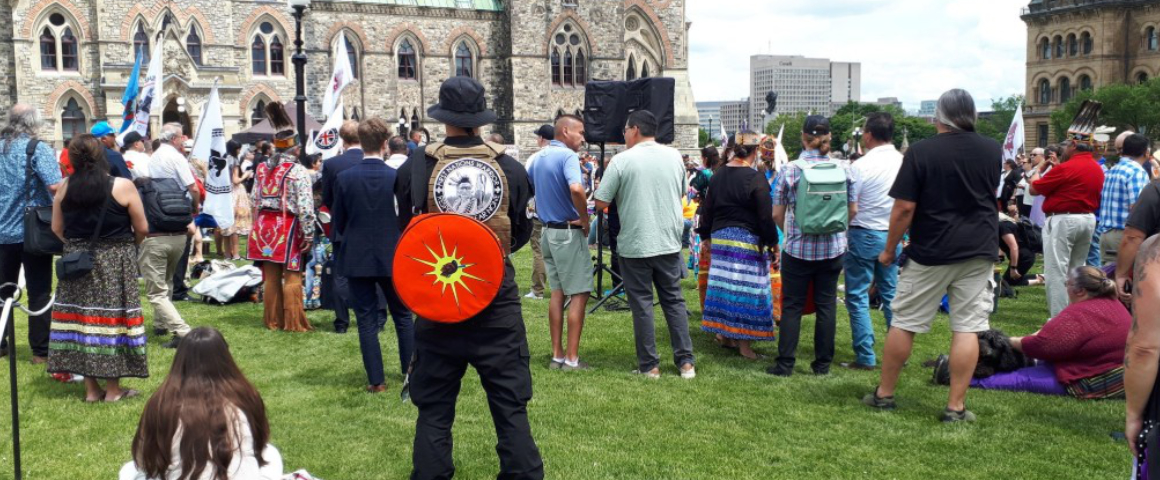
[Photo: PBICanada.org]
Support working-class media!
If you found this article useful, please consider donating to People’s Voice or purchasing a subscription so that you get every issue of Canada’s leading socialist publication delivered to your door or inbox!
For over 100 years, we have been 100% reader-supported, with no corporate or government funding.