By Steve Bishop
Following the unprovoked attack upon Iran by the state of Israel June 13, US President Donald Trump called for Iran’s “unconditional surrender,” while preparing to give the green light for overt military intervention by the US.
The US had already been covertly assisting the Israeli assault by providing backup for its Iron Dome missile defence system, designed to intercept any Iranian missiles fired towards Israel in response.
That the US was even contemplating military intervention in Iran, going against all the norms of international law and the so-called international rules-based order, can only be regarded as an international scandal.
Israel has a decades-long record of flouting international conventions and dismissing UN resolutions, but to be backed so overtly in doing so by its major ally and arms supplier would take the threat to world peace that Israeli action represents to a new level.
The pretext for the action against Iran is that the Iranian uranium enrichment program, being developed for civilian energy generation, is close to the point where it could be weaponized and Iran would have nuclear weapons capability. None of the evidence from the International Atomic Energy Agency (IAEA) or the US intelligence services suggests that this is the case.
In fact, it is Israel that is widely known to have a nuclear weapons capability, though, in line with its official policy of “nuclear ambiguity,” it refuses to confirm or deny the existence of a nuclear arsenal.
While the IAEA has raised “concerns” about the level of uranium enrichment in Iran’s nuclear facilities, it has not suggested that this is at a weapons-grade level. This assessment is shared by US intelligence sources who came to the same conclusion as recently as March of this year. The fact that Iran only increased its enrichment program because the US, in Trump’s first term as president, pulled out of the nuclear program deal agreed in 2015 is conveniently overlooked by the media and politicians in the West.
In spite of the evidence to the contrary, the narrative around the justification for supporting Israeli action has been the mantra that Iran must never have nuclear weapons. This is usually closely followed by the time-worn assertion that Israel has the right to defend itself, a platitude which, since October 2023, has been used to justify Israeli genocide in Gaza.
European governments hung on the coattails of the US, confining themselves to calls for “restraint” or having “expressed concern” over rising tensions in the region, but they have not condemned Israel’s violation of Iranian territory or its blatant ignoring of international law.
Just as there can be no justification for Israel’s genocide in Gaza, the attack upon Iran, especially while the Islamic Republic was in negotiations with the US, has no legal or moral basis.
The attack upon Iran does, however, have a clear political objective, and that is one which has been asserted more prominently in the past few days: regime change.
We must be clear that it is not for Israel, the US or anyone else to bring regime change to Iran. The future of Iran must be for the Iranian people themselves to determine.
We don’t want Israel and the US’s ‘regime change’ playbook inflicted on Iran
In the context of Israel and the US’s unprovoked attack on Iran, it is worth understanding the motivations of some of those pushing regime change in Iran, and the truth of their relationship to the Iranian people.
The Western media has been adept for many years in its obfuscation of the real objectives of the Iranian revolution in 1979, which overthrew the dictatorship of the Shah of Iran.
The revolution was one to establish a national democratic republic and mobilized forces from across the social spectrum, from the organized working class, academics and the clergy. External attempts to subvert the revolution were always a danger, not least the Western-backed attack upon Iran by Iraq, which led to eight years of war from 1980-88, and had a devastating impact upon both nations.
However, the internal dynamics of Iran, with the clergy gaining control of the state apparatus, establishing a theocratic dictatorship and conducting waves of arrests and executions of the progressive opposition, was the fatal blow to the progress of the revolution and the signal for Iran’s retreat into a reactionary medievalism.
On this basis, in line with the wishes of the Iranian people as expressed in their opposition to the dictatorship of the former shah in 1979, and as increasingly expressed in their opposition to the theocratic dictatorship today, popular democratic transition in Iran is vital to secure peace, democracy and social justice for the people of Iran.
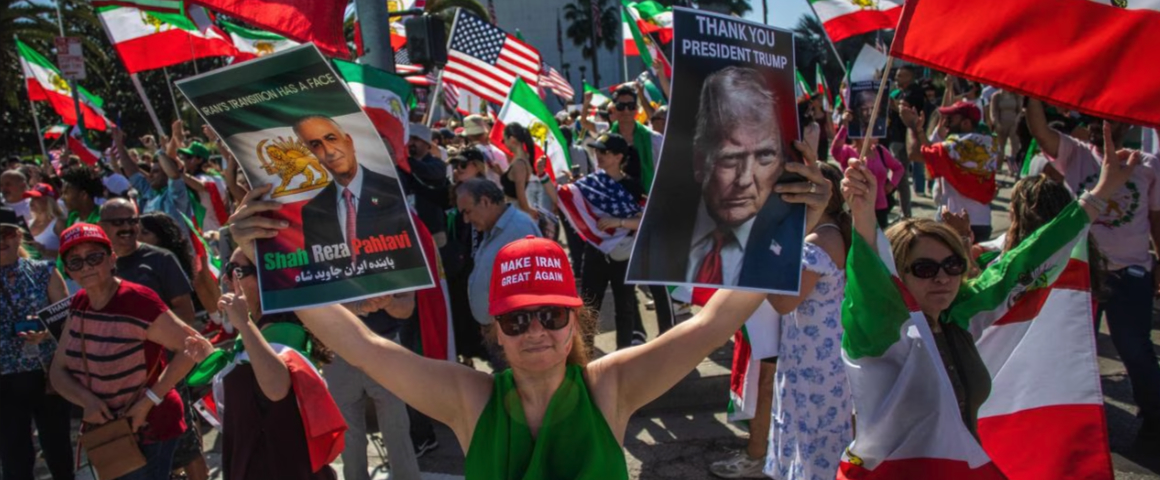
This, however, is not the regime change which Trump in the White House or Netanyahu in Tel Aviv are seeking. On the contrary, a progressive and democratic Iran is the furthest from their minds as support for monarchist opposition in the form of Reza Pahlavi, son of the former Shah, based in the US, is given greater prominence by Western politicians and media.
Netanyahu’s call for Iranians to rise up against the present regime in Iran has been echoed by Pahlavi, who met Netanyahu on a visit to Israel in 2023. The likelihood of Pahlavi being able to mobilize mass popular support inside Iran is slim, however, given his distance from the country and the perception of many Iranians that he is collaborating with the aggressor Israel.
Any return to Iran for Pahlavi would need the significant backing of US or Israeli military forces to suppress the opposition which such a reactionary move would provoke. The danger of Iran becoming a state dismembered by Western imperialism, such as has been the case with Iraq, Libya, Afghanistan and Syria, would be all too real in such a scenario.
An alternative for the West could be backing the Mujahedin-e Khalq (MEK), an exiled group that enjoys support in the US from hawks such as veteran Republican John Bolton. During the 1980s, the MEK backed Iraq in its war with Iran, and the Islamic regime often accuses it of collaborating with Israel. Like Pahlavi, the MEK does not enjoy popular support inside Iran and would require significant external backing in order to maintain any grip on power.
Recent years have seen increasingly popular opposition movements inside Iran. Millions protested disputed elections in 2009 in what became known as the Green Movement. In 2022, the Women, Life, Freedom Movement mobilized millions across Iranian cities, calling for an end to Supreme Leader Ayatollah Ali Khamenei’s rule following the death of 22-year-old Mahsa Amini in police custody after she was arrested for allegedly not properly wearing her hijab.
Workers in the transport, oil, public services and teaching sectors have taken action to improve wages and conditions in spite of trade unions being effectively outlawed in Iran. These are the potential movers of change that Trump and Netanyahu do not want to see – those who are opposed to the theocratic dictatorship but equally do not want to see Iran’s future shaped by the outside interests of Israel or US imperialism.
Change in Iran has been coming for a long time, but it must be change for the people, by the people, not change shaped by foreign intervention and an imperialist agenda, imposed upon the people of Iran.
Steve Bishop is a senior executive member of the Committee for the Defence of the Iranian People’s Rights (CODIR). This article is based on two separate pieces, published in Morning Star, which have been edited together by PV staff
Support working-class media!
If you found this article useful, please consider donating to People’s Voice or purchasing a subscription so that you get every issue of Canada’s leading socialist publication delivered to your door or inbox!
For over 100 years, we have been 100% reader-supported, with no corporate or government funding.