By Cam Scott
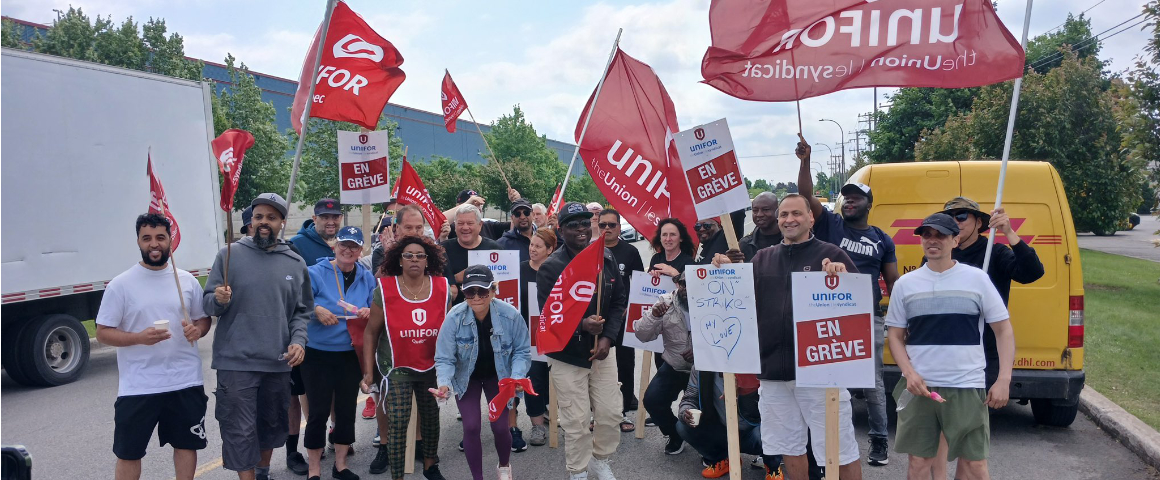
On June 8, after a lockout by the employer, more than 2,000 Unifor members at DHL Express Canada went on strike across the country, with a 97-percent mandate from workers. DHL employees in Canada have been without a collective agreement since the end of last year, and in negotiations with DHL since October 2024.
Not only is the German-headquartered logistics company asking for deep concessions from workers – reducing jobs and shifts, declining to compensate drivers for up to 100 kilometres in transit to their routes, and proposing massive layoffs – their previous offer of a 15-percent increase in wages over five years barely keeps pace with the rising cost of living. Unifor is demanding its 2,100 members receive annual pay increases, guaranteed work, access to bathroom facilities, and the upkeep of basic industry standards across many other areas of concern.
DHL Express Canada has tens of thousands of customers and is part of an intricate supply chain involving many other freight companies and intermediaries. This lockout and subsequent strike have the potential to cause far-reaching disruptions, but DHL has assured the press and its biggest customers of “proactive” measures to protect their profits from the cascading effects of the company’s own bad faith bargaining – namely, the large-scale use of scab labour. Days before the lockout, DHL bused hundreds of casual workers into their facility in Hamilton, Ontario, apparently parading them before unionized employees.
This provocative move by DHL exploits the narrowing window of time in which the company can use replacement labour before new federal anti-scab legislation comes into effect on June 20. As per Bill C-58, An Act to amend the Canada Labour Code and the Industrial Relations Board Regulations, federally regulated employers will be prohibited from using contractors and casual labour to do union work during a strike or lockout, regardless of when they were hired, and from allowing employees in a bargaining unit to cross picket lines.
Whereas at the beginning of the lockout, DHL workers in Brampton had to manually block scabs arriving by bus, now the employer could face fines of up to $100,000 a day for this practice. Shamefully, DHL Express wrote to the federal government asking the Prime Minister and the Minister of Jobs and Families to intervene against the new law under section 107 of the Canada Labour Code, which empowers the Minister to “do such things as to the Minister seem likely to maintain or secure industrial peace.” Unifor National President Lana Payne responded in certain terms. “DHL is not the victim here,” she said. “They chose confrontation. Now, instead of negotiating a fair agreement at the table, DHL is running to Ottawa to ask for special treatment to get around a law designed to protect workers and safeguard the integrity of collective bargaining.”
Bill C-58 is the outcome of years of organizing and advocacy by labour, and Unifor has announced its intent to demand strict compliance of the employer with the new law. But amid soaring profits, it remains uncertain whether DHL intends to flout or even test the resolve of the Canada Industrial Relations Board to enforce this progressive legislation. DHL’s annual profit is approximately $4.6 billion, and the North American branch of its operation accounts for over $9 billion in revenue.
In spite of new tariffs and trade uncertainty, DHL Group posted noteworthy revenue and earnings growth in the first quarter of 2025. “We have successfully handled tough situations in the past,” boasts a media brief naming the 2008 financial crisis and the COVID-19 pandemic.
In fact, DHL made enormous profits during the pandemic, as consumer patterns shifted from in-store to online shopping and necessitated home delivery. DHL also used this period to double down on casualizing practices for which it had previously faced legal trouble, tipping its fleet towards contract workers and owner-operators rather than company drivers. These drivers wear DHL uniforms and display DHL trademarks on their vehicles, but even having assumed the costs of maintenance and ownership themselves, are still facing significantly reduced pay.
The last five years have seen record profits for delivery companies like DHL, and have also coincided with the further restructuring and global dispersal of customer service in pursuit of less stringent labour laws.
Yet at the same time as DHL relies upon the flexibility of customer service in order to weaken union representation, they are intent to do away with work-from-home accommodations as they increase surveillance and automation of in-house call centers in Canada. This follows recent trends in call centres represented by various public and private sector unions across the country, where workers are finding themselves forced back to distant offices or facing layoffs. Here as in the trucking industry, companies rely upon discrepant immigration statuses and general precarity to oblige workers to unacceptable terms.
Unifor represents many types of workers at DHL, from drivers and couriers to warehouse and office workers, and the company’s one-size-fits-all, low-ball proposal insults their various needs even as it fails by the most basic industry standards. As of this moment, DHL remains headstrong, with its Canadian CEO Geoff Wall pledging to shut down operations entirely before Bill C-58 takes effect on June 20.
Timing is everything, and where private companies like DHL are instrumental in the longer plot to dismantle public postal services, the fight of Unifor members in the private sector has the potential to buttress the demands of CUPW as well. With more forceful labour laws just around the corner, the fight of DHL workers for a fair deal could have ramifications for the entire shipping and logistics industry in Canada, and serve as a test of hard-won legislation for the labour movement as a whole.
[Photo: Unifor.org]
Support working-class media!
If you found this article useful, please consider donating to People’s Voice or purchasing a subscription so that you get every issue of Canada’s leading socialist publication delivered to your door or inbox!
For over 100 years, we have been 100% reader-supported, with no corporate or government funding.