By Manuel Johnson
We recently witnessed yet another demonstration of the absence of real democracy in Canada.
Capitalist media and political parties present the electoral process in much the same way as the Stanley Cup playoffs, emphasizing strategies and the qualities of the individuals and teams, all with the goal of predicting the winner. In the playoffs, most attention is paid to the powerful teams while those with no chance of winning receive less attention. So, it’s understandable that in the electoral process, small parties with no chance of forming government are ignored by the media and debate organizers, right?
No, it isn’t – because democracy isn’t hockey. In democracy, the result is less important than the process. And in a real democracy, broad and diverse political debate must be at the center of that process, rather than a popularity contest devoid of political content.
We are fighting for real democracy, where the needs, concerns and interests of the working class – the vast majority – are represented. However, this is precisely what the ruling class – the small minority – wants to avoid.
As a result, several obstacles prevent small parties like the Communist Party from making themselves heard. These obstacles include the first-past-the-post voting system, the lack of equal airtime in the mass media, and the exclusion of small parties’ candidates from election debates. There is also the disparity in available resources, with capitalist parties often spending $100,000 per candidate.
The Communist Party has already been banned by the state on two occasions – from its foundation in 1921 until 1924, and again from 1940 to 1959. More recently, in the 1990s there were more indirect attempts to abolish the Party, through amendments to the Elections Act requiring parties to nominate at least 50 candidates across Canada to maintain registered party status.
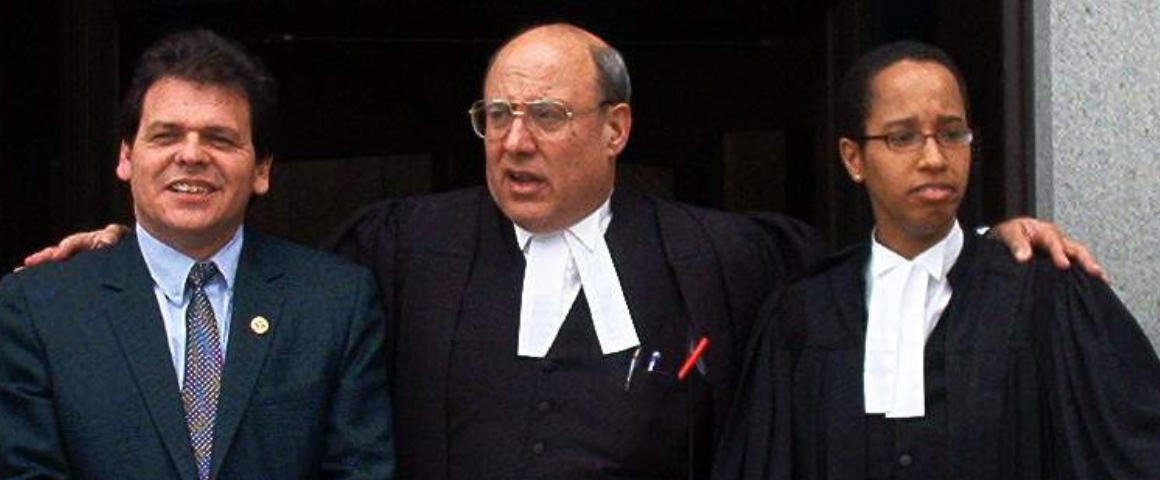
Undeterred by the class nature of justice under capitalism, the Communist Party successfully fought the latter battle for democracy all the way to the Supreme Court [see photo]. This political law case is known as Figueroa v. Canada, named after the Party leader at the time.
In a 2003 ruling, the Supreme Court put forward several essential democratic principles including the right of every citizen to participate fully in the democratic process. According to the court, this means that small parties should not be restricted in their ability to campaign and participate in political debate.
“Participation in the electoral process has intrinsic value regardless of the outcome of the election,” the Supreme Court wrote in its ruling. “The right to seek the votes of voters provides candidates with the opportunity to present certain ideas and opinions to the electorate, and the right to vote allows citizens to demonstrate their support for those ideas and opinions.”
For the Supreme Court, the right to vote protected by the Charter of Rights and Freedoms is broader than the simple right to cast a ballot to choose a government: “The right to vote allows every citizen to demonstrate their support for the ideas and opinions subscribed to by a given candidate. In each case, the democratic rights enshrined in [section 3 of the Charter] ensure that every citizen has the opportunity to express an opinion on the development of social policy and the operation of public institutions by participating in the electoral process.”
So, it is important and necessary to encourage broad participation in political debate, and small parties play an important role in this process: “Regardless of their ability to influence the outcome of the election or not, political parties constitute both a vehicle and a platform allowing citizens to participate usefully in the electoral process.”
Following the decision, Miguel Figueroa noted: “The importance of this judgment is paramount, since it allowed several small parties, not just the Communist Party, to continue to exist, or even to be created. The plurality of democratic debate is essential in a democratic society. It allows the political offer not to be limited to parties financed by capital as in an American-style plutocracy.”
Figueroa also said, “After the judgment was rendered, I received several calls and letters to the effect that despite our political and ideological differences, our victory is historic for democracy in Canada.”
These gains are indeed significant, but they remain unfulfilled if no one ensures they are respected. The recent election campaign demonstrated this, when several local debate organizers prevented Communist Party candidates from fully participating in the “battle of ideas,” ensuring that established parties enjoyed an unfair advantage.
When we have the opportunity to present our program for peace and disarmament, for employment, for strengthening and expanding of public services, for massive social housing and for reducing the power of corporate monopolies, people respond favourably. But these ideas are dangerous for the ruling class and, therefore, we must be censored.
In doing so, it is the right to vote that is directly attacked – and it is democracy that takes a hit.
Clarté
Translated from French by PV staff
Support working-class media!
If you found this article useful, please consider donating to People’s Voice or purchasing a subscription so that you get every issue of Canada’s leading socialist publication delivered to your door or inbox!
For over 100 years, we have been 100% reader-supported, with no corporate or government funding.