By Rozhin Emadi
The Social Justice Committee of the West Vancouver Teachers’ Association recently hosted a powerful screening of the documentary Union at the Rio Theatre, an independent venue known for showcasing thought-provoking films that challenge us to engage with complex issues. This event brought together educators, students, union members and community leaders in a shared space to reflect on the power of collective action.
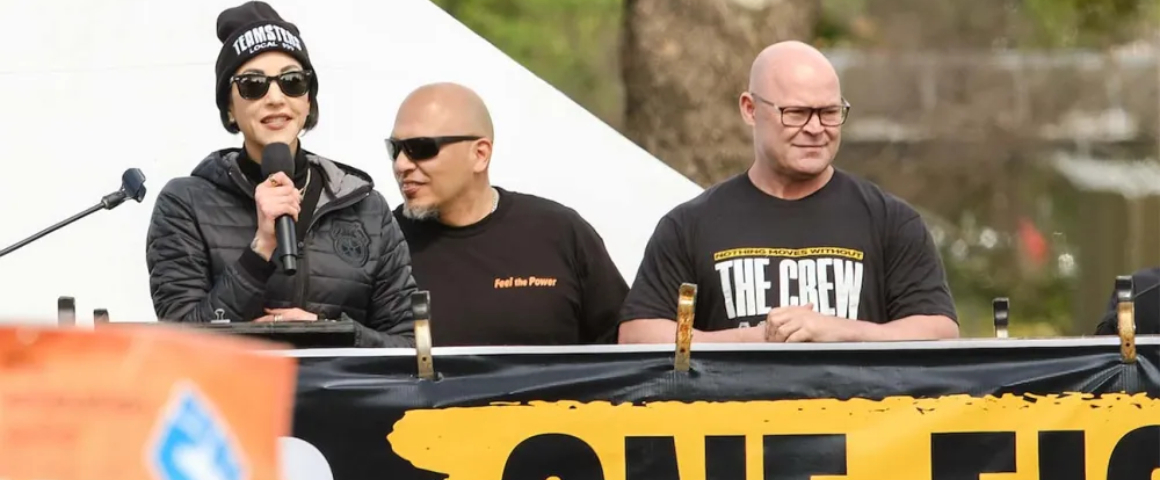
Following the screening, attendees had the opportunity to participate in a live Q&A with Chris Smalls, founder and former president of the Amazon Labor Union. The discussion was facilitated by two exceptional senior students from West Vancouver Secondary School, who are involved in social justice initiatives in their school community.
The event was supported by several labour unions across British Columbia and featured inspiring speeches from three prominent union leaders: Clint Johnston, President of the British Columbia Teachers’ Federation; Rob Ashton, President of the International Longshore and Warehouse Union of Canada; and Sussanne Skidmore, President of the BC Federation of Labour. Their messages reinforced the importance of union solidarity and the ongoing fight to protect workers’ rights and promote social justice.
Notably, the event was held just two days before the anniversary of the 1919 Winnipeg General Strike, when 35,000 workers across various sectors united to demand the right to collective bargaining. This historical context deepened the resonance of the evening’s themes and reminded us of the long tradition of worker-led movements for justice.
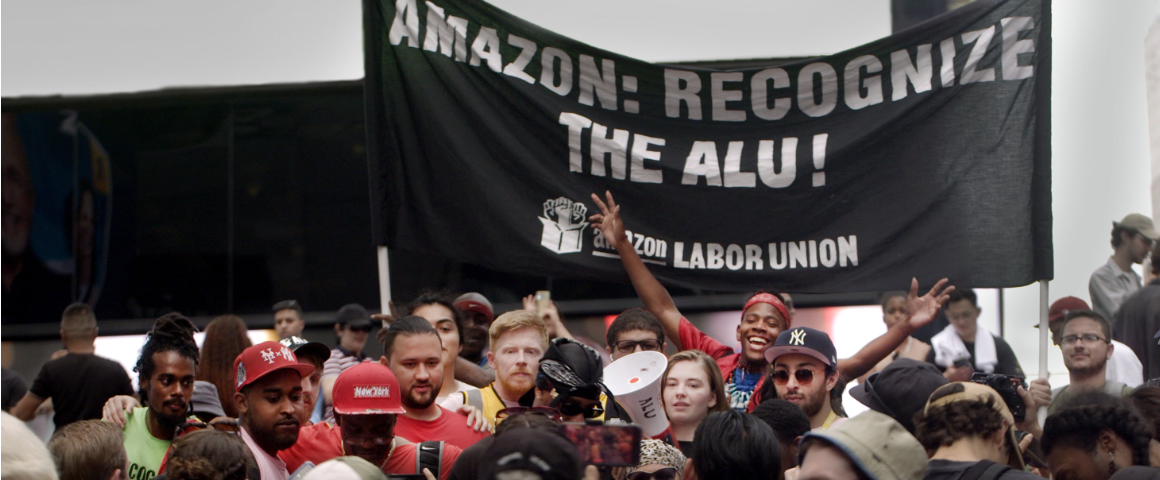
Directed by Brett Story and Stephen Maing, Union documents the extraordinary efforts of a diverse group of Amazon warehouse workers in Staten Island, New York, who banded together to launch a grassroots union campaign. Despite immense odds – including facing off against one of the world’s most powerful corporations – their perseverance led to the formation of the first Amazon Labor Union in the United States. The film highlights not only their struggle but also the deep sense of community and solidarity that unions can foster.
Unions are more than a tool for workplace fairness – they are vehicles for broader societal change. They help build a global community of workers fighting together for fair wages, strong public services, environmental protection, peace, more just democratic processes, and political power. In a world increasingly shaped by inequality, climate crisis, political instability and global conflicts, the role of unions has never been more vital.
We are living in challenging times. Inequality is rising, and so too are racism, xenophobia, attacks on women and LGBTQIA2S+ communities, and the erosion of our environment and democracy. Economically, many working people are struggling. In the US, 78 percent of Americans live paycheck to paycheck. In Canada, reports indicate that half of Canadians are just $200 away from bankruptcy at the end of each month. The Broadbent Institute notes that 50 percent of Canadians own less than 6 percent of the nation’s wealth, while the top 20 percent hold over 70 percent. Women, in particular, face even more economic hardships – 1.5 million live in low-income households, and 1 in 5 women live on low incomes.
Meanwhile, billionaire wealth continues to skyrocket. In just the first month of this year, it grew by over $300 billion – more than the combined wealth of the poorest third of humanity.
In this context, the labour movement must rise to offer a compelling and progressive alternative. Without it, far-right movements are able to manipulate people’s economic difficulties and scapegoat marginalized communities for the very injustices caused by unchecked corporate power and inequality. We cannot let that happen.
As trade tensions and nationalism increase between countries like the US and Canada, international solidarity among workers is more important than ever. Our shared struggles unite us far more deeply than borders divide us. We must remember: we have more in common with working people around the world than we do with the billionaire class here at home. And the labour movement has a duty of reminding the working class of this point.
However, today only 10 percent of US workers belong to a union, and organized labour continues to face attacks – especially under anti-union political rhetoric. In Canada, union density is only around 30 percent. Clearly, there is much work to do. Therefore, the film Union, alongside the motivating words given by Chris Smalls at the event, serves as a timely and inspiring reminder that organizing is not only possible – it’s powerful.
In a world saturated with discouraging headlines, it’s easy to feel overwhelmed. But as educators, activists and community members, we must stay informed and empathetic – and committed to action. We owe it to ourselves, our students and our communities to keep fighting for a better, more just world.
Let’s organize, educate, and fight – for people, for the planet, and for a future that prioritizes justice over profit. We have a world to win.
Support working-class media!
If you found this article useful, please consider donating to People’s Voice or purchasing a subscription so that you get every issue of Canada’s leading socialist publication delivered to your door or inbox!
For over 100 years, we have been 100% reader-supported, with no corporate or government funding.