By Jad Kabbanji
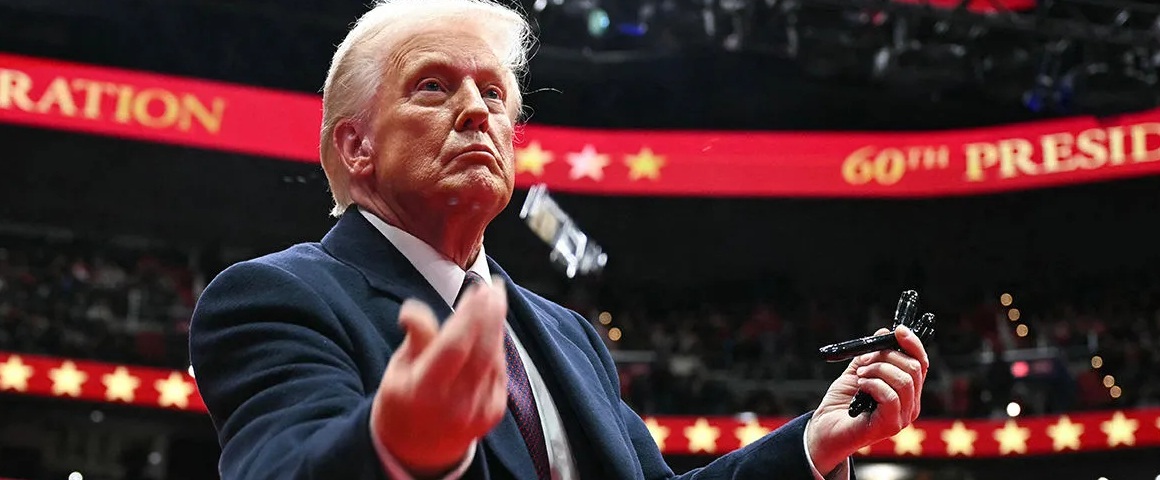
Since his re-election in November 2024, Donald Trump has resoundingly reignited debates on US foreign policy. Behind his provocations and aggressive populism lies a central question: are we witnessing a new form of imperialism or a simple tactical transformation of an already well-established system?
The concept of imperialism is too often reduced to geopolitical power struggles. This superficial view confuses causes and consequences: rivalries between states are simply the reflection of a deeper logic, that of economic domination by corporate monopolies. Imperialism is not simply a question of military power or political influence; it is above all a global system where large corporations extend their reach to control resources, markets and strategic areas.
Political power in the United States, controlled by US monopolies, is the archetype. Their hegemony has been built over time on a mixture of soft power (trade agreements, humanitarian aid, mass culture) and hard power (military interventions, sanctions). Under Trump, this balance is shattered. Hard power – blackmailing allies, brutal economic sanctions, targeted interventions – is becoming the dominant tool, while soft power is being partly sacrificed.
This development does not mark a rupture, but an adaptation of an imperialism in crisis, confronted with the rise of China and the exhaustion of a crumbling neoliberal model.
Forced austerity, militarization and sabotage of international institutions
Trump embodies a ruthless logic: to save US hegemony, friends and enemies must be cannibalized. His strategy is based primarily on three interdependent axes.
First, isolate China. Far from the free trade of the 1980s, which allowed Beijing to become a rival, Trump imposed 10 percent tariffs on Chinese products. The objective is to protect US monopolies while attempting to strangle the Chinese economy.
Second, blackmail NATO. By demanding that member countries increase their military spending to 5 percent of GDP, he is imposing massive cuts in social budgets. Public spending – health, education, housing – is being sacrificed to finance the purchase of US weapons, fattening arms giants like Lockheed Martin and Raytheon.
Finally, sabotage multilateral institutions. The UN, whose budget is being suffocated by the cessation of payments from the United States, is weakened in its role as conflict regulator. For Washington, this is a godsend: a weakened UN system leaves the field open to military and economic expansionism.
Trump is simply continuing the policies of previous US governments, but in a context that demands a more authoritarian style and methods. Biden razed Gaza while marginalizing the UN during the genocidal war, paving the way for Trump, who now speaks of the forced displacement of Palestinians. Similarly, Biden initiated a protectionist policy by taxing Chinese products and renegotiating the United States-Mexico-Canada Agreement (USMCA) to favour US interests, a policy that Trump is now threatening to implement in practice by imposing a 25 percent tariff on Canadian and Mexican products.
In reality, Republicans and Democrats are two faces of the same imperialist system, where the methods vary but the objectives remain the same: to serve the monopolies and maintain US domination, even if it means plunging the world into chaos.
Canada’s voluntary servitude to the American Empire
Canada, economically tied to the United States via the USMCA, illustrates the ravages of this imperialist strategy. Quebec’s subsoil, rich in strategic minerals such as lithium and rare earths, is already being used by the US military for its high-tech weapons projects. In the West, Alberta’s oil sands, exploited by giants like Exxon and Chevron, symbolize this economic and environmental dependence.
Ottawa, subject to Washington’s dictates, plays the “good boy.” Under threat of trade sanctions, Mark Carney has promised to reach 2 percent of military spending by 2030 – a 40 percent increase in the budget since 2024. This money, diverted from essential public services, is financing massive purchases of US weapons like F-35s, missile systems and other lucrative contracts for arms monopolies.
Defence Minister Bill Blair even announced Canada’s intention to join Trump’s “Iron Dome” missile shield project, a costly program that strengthens the US military’s hold on Canadian territory.
This subservience is not limited to federal circles. Doug Ford, a public critic of Trump, called during a visit to the United States in February 2025 for “working together” to “strengthen economic and security ties.” This is a euphemism for validating alignment with Washington’s imperialist priorities.
François Legault, for his part, openly advocates for Quebec to serve as a bulwark against “China’s influence” by supplying the United States with strategic minerals such as lithium, graphite and gallium. “Canada shares the same concerns as the United States regarding China, and we should align ourselves more closely with the US strategy, including adding additional tariffs to the measures already in place,” he declared. This discourse transforms Quebec territory into a mere extractive reserve, serving US geopolitical ambitions while sacrificing the interests of local communities and the environment.
This widespread submission, at both the federal and provincial levels, reveals a disturbing reality: political leaders in Canada are ready to bow down to the hard cash interests of the monopolies and to sacrifice sovereignty on the altar of US imperialism.
Against imperialism, only the struggle counts
Far from dividing, Donald Trump’s belligerent aggressiveness has the merit of crystallizing popular opposition to US interference in Canadian affairs. For peace advocates, this momentum represents a historic opportunity. In a context of existential threat and therefore widespread war, it is imperative to act now.
Canada, the target of US pressure, must defend itself. But not in the name of a facade of sovereignty, that of leaders who bow to monopolies and NATO. The sovereignty to be defended is popular: it requires the nationalization of key sectors of the economy, reindustrialization under public control, and immediate withdrawal from NATO.
These measures are not slogans, but concrete levers to break Washington’s imperialist grip. Around them, unions, environmental movements, anti-monopoly parties, anti-war organizations and the people can and must unite. The coming years will be decisive: either we allow humanity to sink into the predatory logic of imperialism, or we build a united front, determined to ensure the triumph of peace and justice. It is up to us to choose, and to act.
Peace is not negotiable; it is won through struggle. And the sovereignty of peoples is not negotiable; it asserts itself.
Clarté (Translated from French by PV staff)
Support working-class media!
If you found this article useful, please consider donating to People’s Voice or purchasing a subscription so that you get every issue of Canada’s leading socialist publication delivered to your door or inbox!
For over 100 years, we have been 100% reader-supported, with no corporate or government funding.