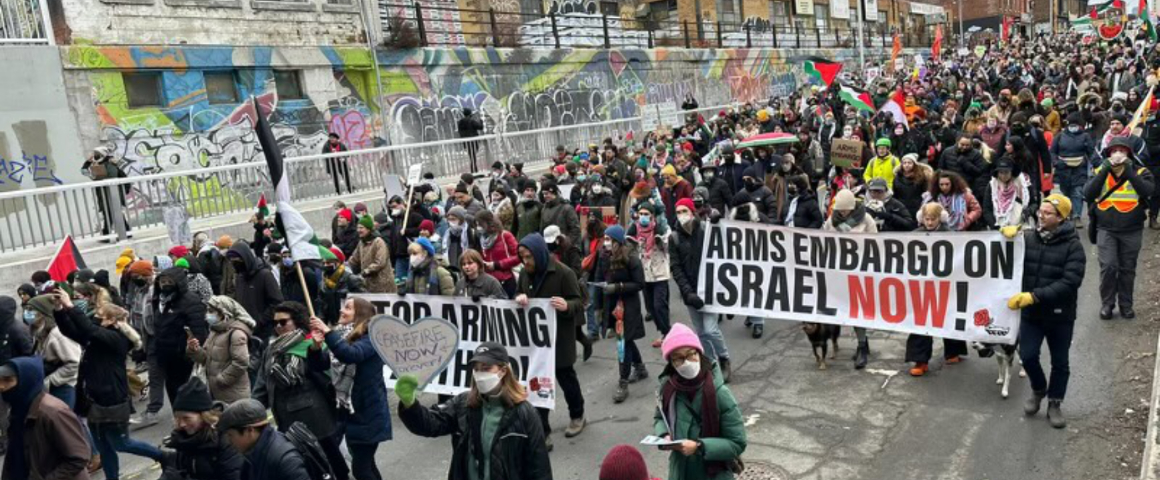
On January 30, PV Forum hosted its first 2025 event in Toronto. “Reflections and Lessons from Anti-Apartheid Organizing in Canada” featured a discussion among three panelists: Domenic Bellissimo, a veteran of the South African anti-apartheid struggle in Canada; Enver Domingo, a native South African and member of the ANC during South African apartheid; and Pamela Arancibia, a coordinator at Labour for Palestine. For this article, the last in a three-part series, PV forum organizer Peter Saczkowski spoke with panelists about the necessity and dynamics of coalition building for the long-term struggle.
Peter Saczkowski: If we look historically at what happened around World War I and World War II, it was in many ways the imperialist mindset sort of coming home to roost in Europe. We think of ourselves as sheltered in the West from all of this violence, but the sort of fascist machinations that we see Western powers subject the Global South to always tend to come home eventually.
But this fact that human rights are universal really speaks to so many people at so many levels, no matter what their sort of ideological attunement is. And that helps build a foundation for coalitions.
Enver Domingo: That is true, and we’ve got to hammer away at this consistently. Coalition building is very, very important. It was a key part of our South African national liberation struggle.
We found, especially overseas and in Western countries, that there were different anti-apartheid support groups with different philosophies and ideologies. Speaking as the National Congress or the Congress Alliance – which included South African Congress of Trade Unions and the South African Communist Party – we knew who our true friends were, and those friends gave us unconditional support. No limits, no hesitation.
There were other groups who did not give us unconditional support, but that didn’t mean we shut them out. The important thing is to invite them in, even if they only come halfway, but do not encourage or participate in one group fighting another group.
I’ve seen this happening now within Palestine support groups in Canada.
And what happens? People spend so much energy criticizing each other—how good, hard, true or pure they are compared to another group. The result? People get disillusioned.
And that is a detriment to the anti-apartheid struggle, and we overcame that.
I remember visiting the United States and finding that many people didn’t even know about Nelson Mandela. They didn’t know much about the African National Congress (ANC) – they knew more about the Pan-African National Congress (PAC). But I never, ever said, “Well, the PAC is just that…” No, no, no. Bring them on board, gradually.
But always look for the common link – the why. Why are you allowing investments in occupied Palestine, aiding the Israeli military, when that money could be better used for improving wages, healthcare, etc.? We make those connections, because it’s difficult.
We know that Zionists, especially in the West, control the narrative, and we must defeat that.
Pamela Arancibia: You know, in Toronto, I think for the first year and a half since October 7, we’ve been in reaction mode. There’s always something urgent, some crisis, some new escalation from Israel. And in that sense, our response has been piecemeal.
Where possible, labour and groups like Labour for Palestine have tried to respond on the labour side. Arts and culture workers have tried to respond in their own spaces. The Palestinian Youth Movement, as an organization led by Arab youth, has been working to mobilize their community.
But ultimately, we’ve been overwhelmed, constantly reacting. And we all know that this moment, the current ceasefire [the January 19 ceasefire, which was still in place at the time of this interview] is only a temporary reprieve – it hasn’t even fully been that. But we know what’s coming.
And I do think this is a moment where we need to … not pause, because we don’t have that luxury, but at least slow down enough to ask: How do we move forward, understanding that this is long-term work?
I think a proper coalition is essential. Because, really, what we’re fighting is cultural hegemony – the concept Gramsci talks about. Israel has held, and continues to hold cultural hegemony. We’re breaking it down and replacing it with our message, which is based in truth. But that’s what we’re up against.
For us to change that, so that our messaging is the one that gets absorbed and internalized, we need to reach society at every level. And no single group or organization can do that alone. That requires a coalition. A coalition needs to be as broad as possible.
We’re going to have differences. We’re not going to agree on everything. This idea of ideological purity is outrageous, and we cannot allow it. If there’s a Conservative MP who is willing to take on this issue, we might hate everything else they stand for but we will have a moral obligation to at least say: “Look, I think we disagree on everything else. But we agree on this.”
Because society at large needs to be able to say, “We have ideological differences, but we can all agree that genocide is wrong.” We can all agree that apartheid is wrong. We can all agree that killing children is wrong.
And that shouldn’t be ideological. It should be universal. Of course, coalitions come with challenges. We’ll have to navigate different politics, approaches and tactics. But we can find some kind of unity, some basic principles that we all agree on. And if we agree on those, we can work together, even if we might be adversaries on other issues.
I’m inspired by a Latin American phrase: “Vamos por ancho camino” – the idea of walking a broad path. And we need to bring as many people into that path as possible.
Domenic Bellissimo: I agree. And I think that’s the challenge right now because we’re going to see a tailing off of activism from people who were motivated over the past year to get involved.
If we don’t create a network or coalition, like you’re saying Pam, that has a minimum program that people can sign on to, we risk losing momentum. Differences of opinion can be worked out down the road, but a solid foundation needs to be built now.
I do think that, as soon as possible, having Palestinians themselves be part of a speaking tour would really inspire people in Canada to form a network and stay active. Knowing that the constitution will be drafted by Palestinians themselves, not by us in Canada, is an important perspective to reinforce.
We can’t stop Trump in Gaza. We can pressure Canada to oppose it, but ultimately, we need to count on activists within Jordan, Egypt and other parts of the world saying, “This is outrageous, what Trump is proposing,” right?
So, creating that network – finding people who have the credibility to bring others together, even those who might normally disagree on economic outlooks or different solutions for Canada’s economy – is crucial. But they can work together on this.
During South African anti-apartheid work, the broadest unity was achieved when demands focused on the action of dismantling apartheid rather than debating the ideal “post-apartheid government.” So, I think that’s the urgent challenge for groups like Labour for Palestine, Palestinian Youth Movement and all the others as well.
Enver: Yeah, I agree. We need a broad coalition – put aside your ideologies and let’s work toward a common objective. And the moment is now – we cannot afford to wait.
The idea of having Palestinian spokespeople in the country is vital. We need the Palestinian voice, and we should not involve ourselves in drafting the constitution of a free Palestine. That is up to the Palestinians themselves, just as it was our right to determine our constitution within the African National Congress (ANC). The people of Palestine have that same right, both within Palestine and within the Palestinian diaspora.
So, the time for a broad coalition is now. We have to pressure the Canadian government now. We need to form connections with international allies, as we already have.
I sit on the steering committee of Canada BDS and our international allies. We have South Africans, Tunisians and Palestinians actively working with us, because we recognize the importance of unity and the need for strong connections including with the Palestinian Trade Union Federation.
Domenic: You made me think that we need to start framing our language differently than we have over the past year. We need to be talking about a free Palestine. We need to be talking about liberation and ending the occupation.
The network that’s being set up, for example, should have a broad membership united around the longer-term project of a free Palestine and liberating Palestinians. I think that’s going to be the demand for the next year, two years or even three, because these ceasefires will come and go, but what remains is the violence of the occupation, right?
I’m not even aware of whether we have 50 organizations or 100 working in Canada on behalf of Palestine, but if we had proper mapping and invited groups to come together, I think it would work. I think people would feel that there is a need to remain strong by uniting and challenging the anti-Palestinian narratives and structures in Canada.
Support working-class media!
If you found this article useful, please consider donating to People’s Voice or purchasing a subscription so that you get every issue of Canada’s leading socialist publication delivered to your door or inbox!
For over 100 years, we have been 100% reader-supported, with no corporate or government funding.