On January 30, PV Forum hosted its first 2025 event in Toronto. “Reflections and Lessons from Anti-Apartheid Organizing in Canada” featured a discussion among three panelists: Domenic Bellissimo, a veteran of the South African anti-apartheid struggle in Canada; Enver Domingo, a native South African and member of the ANC during South African apartheid; and Pamela Arancibia, a coordinator at Labour for Palestine. For this article, the second in a three-part series, PV forum organizer Peter Saczkowski spoke with panelists members about the role of the labour movement in international solidarity and anti-apartheid organizing.
Peter Saczkowski: During a recent labour convention, one union executive stood up and started talking about Palestinians beheading babies – this debunked pro-Zionist position – which was supported by a number of other labour leaders there.
When holding them to account, one of the positions that actually undermined them within our local was, “Why are you pontificating about this struggle when, first of all, you don’t know much about it, but also Palestine has nothing to do with our specific concerns here in our local?”
So, disconnecting us from international solidarity seemed to work as a way to undermine this labour leader’s credibility in that position. It was like, you should just not be political in that way at all – let’s just focus on our own labour issues.
Obviously, the struggle for Palestinian liberation is an anti-imperialist struggle. And understanding what that means tells us that this struggle is constitutive of our struggle as workers here in the West.
So, I was wondering – though the idea of anti-imperialism and imperialism gets bandied about a lot – if you could talk a little bit about what the connection is between our struggles for justice here in the West and the struggle for Palestinian liberation.
Domenic Bellissimo: Unions today are not the unions of 40 years ago, and labour leaders are not the same as the Bob Whites, the Jean-Claude Parrots and the Grace Hartmans of the past.
What do I mean? Back then, they were seen as trade unionist leaders first – not as politicians. But today, many, if not most union leaders see their position as a political stepping stone until they move on to the next stage of their career.
In education, for example, many see themselves as temporary leaders of a union, not really defined by much outside of the mainstream ideological framework. Many of them will run for government afterward, move to an international body, or work for the government in an education capacity.
They are not seen as trade unionists prepared to go to jail by defying back-to-work legislation, for example.
What I find today is that there are very few labour leaders – except for some who have been developed and encouraged through Labour for Palestine – who have been brave on the issue of Palestine. They are much more comfortable fighting against different forms of inequity, engaging in caucus politics, identity politics and human rights in general, without drawing a direct comparison to an anti-imperialist or liberation struggle like Palestine.
Labour leaders today are far more sensitive to losing their positions due to backlash than they were in the days of Bob White and Jean-Claude Parrot.
Pamela Arancibia: Most of our union leaders – I rarely hear them talk about imperialism. Our union education is often built on a liberal model, and that’s the kind of education that union leaders themselves have been trained in as they’ve moved up the ranks.
They feel comfortable talking about anti-racism. They feel comfortable talking about gender issues. They feel comfortable talking about human rights. But I don’t think many of them actually speak from a position of anti-imperialism. They don’t often connect the idea of rights and intersectionality to an understanding of what imperialism is, how it manifests, how—from our position in North America—we have participated in it, promoted it, and profited from it.
So, I think that’s a missing piece.
People ask me, “Why should I care about Palestine?” or “What does Palestine have to do with our bread-and-butter issues?” I think one thing that must be emphasized is that while we should teach about imperialism and anti-imperialism, we also have to reinforce a fundamental principle: rights are universal. If rights only belong to a select few, they are meaningless. They mean nothing to us, and we shouldn’t be fighting for them if we believe they don’t apply to all human beings.
We cannot ask for fair working conditions here if we don’t believe that every worker, everywhere, has the right to fair working conditions. Otherwise, we are reinforcing a hierarchy of humanity, deciding who counts and who doesn’t. And if my neighbour doesn’t count, then I don’t count either. And you don’t either.
It cannot be that some people are special and deserving of rights while others are not. So, we need to get back to that idea of universality.
If we believe that fair working conditions matter, if we believe that human rights are at risk, then that belief must apply to everybody. And that means we must protect the rights of all people, including Palestinians.
Otherwise, we’re next. And people really need to understand that – we are next.
These things are coming to us as well. Yes, yes, we are already surveilled but not to the degree that Palestinians have been. That level of surveillance is coming to us. Detainment. Camps. These things are coming here, too.
We are starting to see what that future might look like – right near us. In the United States, for example, it’s already happening. ICE is rounding up migrants. People are being encouraged to snitch on their neighbours.
Indigenous people know what this looks like – being displaced, subjected to violence, being framed as a security threat to those who actually create the threat, etc. – but many of us haven’t experienced this at the level that other communities have historically, and so we’ve been sheltered from it.
Part one of this series:“Internationalism, identity politics and anti-apartheid organizing”
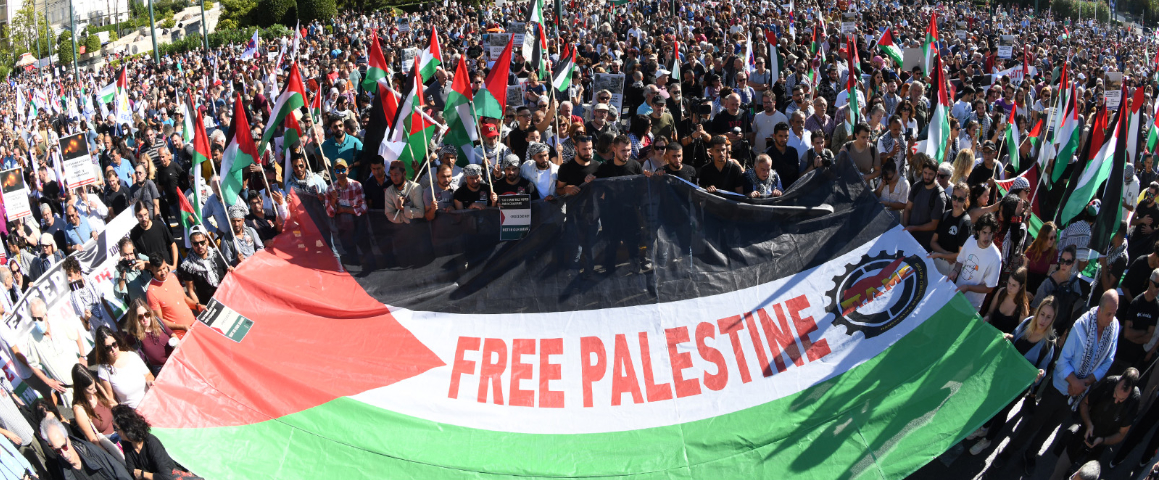
[Photo: Greek workers’ organization PAME demonstrates in solidarity with Palestine]
Support working-class media!
If you found this article useful, please consider donating to People’s Voice or purchasing a subscription so that you get every issue of Canada’s leading socialist publication delivered to your door or inbox!
For over 100 years, we have been 100% reader-supported, with no corporate or government funding.